General Care Discussion :: Shedding and shell question

Taking care of your turtle's overall health.

Post Posted: Thu Aug 30, 2007 7:04 pm   Shedding and shell question

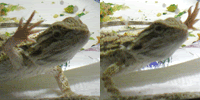
Hercules has been in the process of shedding for a few months. His back seems to be shedding really well, the scutes are coming off easily on their own. The fresh scutes underneath are a much lighter color, which you'll see in the pictures. However the marginal scutes and his plastron seem to have many layers built up, like he hasn't shed them in a long time. When he's dry his belly is peeling all over the place, 3 and 4 layers in some places, but they're not coming off on their own. I don't think the marginal scutes are ready to shed yet but they're starting to lift at the edges and I'm seeing the same thing, many layers lifting together. So I'm wondering if anyone knows what's up with that and if there's anything I should be doing about it. This is the first time he's shed since he's been with me (ie with proper heat and light and swimming room)

I'm mainly concerned though, that some of the marginal scutes have white stuff along the edges. It wasn't there before he started shedding, so it's fairly recent. He had some odd spots before he shed that worried me (which came off when he shed, and were different from this) so since then I've been washing his shell with hibiclense or betadine once a week as a preventative measure. I'm hoping it'll all come off when he sheds those scutes, but I'd like to know what I'm dealing with. I'm hoping it's just mineral deposits or something harmless. Anyway, here are the pics, see what you think. (Sorry it's hard to see, it didn't show up so well in the pictures, also, the whitish spots across his back are just air bubbles, so don't worry about those!)

Image
Image
Image
Napoleon - Western Painted Turtle
Apollo - Eastern Box Turtle
Moxie - Painted Turtle Mutt
RIP Hercules

Katie

I heart my herpies!
User avatar
Starchick
 
Posts: 1399
Joined: Jan 3, 2007
Location: central NY

Post Posted: Thu Aug 30, 2007 7:18 pm   

The marginals are usually the hardest ones to shed. Both my RES had retained scutes so it was even more difficult for them to come off. Since Hercules' shell looks real good and smooth, you just need to wait. I had to give my RES a little help, and as you can see in your pic, it's really that translucent edge that makes it tough to shed. If there is space beneath the entire marginal and it's being stubborn, you can gently tug it up and down to see how loose it is. If its not budging, then I would leave it for a few days, then try again. Just another thing, since you have males and you will need to hold them for this, be extra careful of some fanning due to a bit of distress.

*edit* I'll PM you for a more specific idea of what I did.
User avatar
steve
Site Admin
 
Posts: 31567
Joined: Apr 11, 2005
Location: New York, NY
Gender: Male

Post Posted: Thu Aug 30, 2007 8:14 pm   

I completely skipped over the "white stuff" part of the question. I wouldn't worry about that until you see what it's like after it shed.

The fungal/yeast infection I had to deal with started at one specific area then spread outwards. If all of the retained scutes have it, I would think that it is some trapped mineral deposit under the scute.
User avatar
steve
Site Admin
 
Posts: 31567
Joined: Apr 11, 2005
Location: New York, NY
Gender: Male

Post Posted: Fri Aug 31, 2007 12:42 am   

I was just going to post the same thing about my adult Painted. She is in the process of shedding as well and I was worried about her plastron. Is it safe to use hibiclense when they are shedding (I don't know if some can get stuck under the scutes and then contaminate the water)? If so, what is the proper dilution of it?
1 Pekin Duck- Bumby
1 Adult Midland Painted Turtle- Nyx
2 Hatchling Midland Painted Turtles- Gimli, Marvolo
1 Normal Gray Cockatiel- Egore
User avatar
Bumby's Mom
 
Posts: 751
Joined: Jul 20, 2007

Post Posted: Fri Aug 31, 2007 1:07 am   

I was told to use a 50/50 Hibiclense/water solution. Let the turtle soak for about 20 minutes, and then rinse well before you place her back into her tank. I don't know about for just shedding, though. My turtle had some minor shell rot issues.
RES, Nicaraguan slider, Chinese Golden Thread, Northern DBT, Eastern Painted, Gibba turtle, Leopard tortoise, 3 Central American Woods, 2 Home's Hingeback tortoises, False Map, Northern Map, 2 Pink bellies, Reeves
User avatar
lotsofpets
 
Posts: 439
Joined: Sep 5, 2006
Location: Lexington, KY

Post Posted: Fri Aug 31, 2007 1:34 am   

Hibiclense is a disinfectant. I don't see why it would make any difference to normal shedding but of course if there is some infection present it wouldn't hurt. What helped Spot to shed was lots of basking and dry docking so his shell dried out regularly and good UVB. I've also read that if a turtle is having difficulty shedding it may be due to a need for more vitamine e.
SpotsMama
User avatar
SpotsMama
Retired Mod
 
Posts: 8079
Joined: Jun 7, 2006
Location: Mesquite Texas

Post Posted: Fri Aug 31, 2007 1:57 am   

Wow...Do painted turtles normally have scutes like that? like the lines are all bumpy and the scutes are all jumbled.
2 Chinese Goldenthread turtles ~ Miso&Mafan
1 Chinese Box turtle ~ Chief Lemon
2 Redfoot Tortoises ~ Sheegua & Muugua
1 Toy Poodle ~ Pudding
3 firebellied newts ~ Cassandra, Mr.Poo, and Wiggles.

http://flickr.com/photos/the_naturalist
User avatar
Tenodera
 
Posts: 2886
Joined: Mar 5, 2007
Location: Taichung, Taiwan

Post Posted: Fri Aug 31, 2007 7:40 am   

Hercules is special :) He has a bunch of extra scutes down his back, and they're much more irregular shaped than Napoleon's.

Napoleon - Western Painted Turtle
Apollo - Eastern Box Turtle
Moxie - Painted Turtle Mutt
RIP Hercules

Katie

I heart my herpies!
User avatar
Starchick
 
Posts: 1399
Joined: Jan 3, 2007
Location: central NY

Post Posted: Fri Aug 31, 2007 10:50 am   

Hercules looks great, even with only 1/2 of the scutes shed!

The white on the scutes looks like normal mineral deposits to me. As long as the shell isn't pitting or soft in those white areas, then the white should just fall right off with the scute when he sheds.

The scutes on the belly are the hardest to shed. Sheba only sheds those once every 4 yrs or so (!). One thing I am told is that shedding is easier when the turtle has a good Vitamin E source. Fresh blueberries are a great source of vitamin E so I keep those handy as treats for her (plus, I like to eat them too, LOL).
Kristin's Pond! Starring:

RES = "Sheba", 21+ yrs. old
African Clawed Frog = "Prog", 10 yrs old
& "Kristin" as Momma
User avatar
industrial_girl_2000
Senior Member
 
Posts: 3232
Joined: May 11, 2006
Location: Farmington Hills, MI

Post Posted: Fri Aug 31, 2007 8:32 pm   

I wasn't going to use it for her shedding, she has a lot of damage on her shell that I thought I had cleared up about a month ago but it isn't looking so good anymore. She is shedding though and I was concerned about using it when they are shedding since I don't know if it is a good idea or not. Maybe I should post some pictures of her shell so everyone can give me some adivce? She has already been to a vet and was given antibiotics in case she had an infection and they told me to put Tricide on her wounds and let it sit for about 30 minutes but I was also putting on aintibiotic ointment and letting that sit for about 15 minutes before returning her to the water. It cleared up and was looking good for awhile, I guess I just didn't use it long enough?
1 Pekin Duck- Bumby
1 Adult Midland Painted Turtle- Nyx
2 Hatchling Midland Painted Turtles- Gimli, Marvolo
1 Normal Gray Cockatiel- Egore
User avatar
Bumby's Mom
 
Posts: 751
Joined: Jul 20, 2007

Post Posted: Sat Sep 01, 2007 3:59 pm   

The white along the seam (not on the marginal scutes) looks like a very thin layer of scute that hasn't come off yet. The wide translucent area on the marginal scutes shows that they've been pushed out quite a bit by the new ones. They should shed at some point.

I've found that painteds' shells are more prone to developing problems compared to the shells of RES.
"You become responsible, forever, for what you have tamed." -Antoine de Saint Exupery-
marisa
Retired Mod
 
Posts: 12993
Joined: Apr 21, 2005
Location: CT, USA


Return to General Care Discussion

Who is online

Users browsing this forum: No registered users and 340 guests