General Care Discussion :: ? About lighting..please help

Taking care of your turtle's overall health.

Post Posted: Sun Mar 18, 2007 3:30 am   ? About lighting..please help

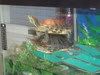
I have a quick question... Ive had Tobi since she was a couple months old and she is 4 now. My question is...well since I saw this site (a few months ago) I knew nothing about lights on and lights off (heat or UVA/UVB) at 12 increments. So since she was tiny she has ALWAYS had her heat light on 24/7 and her UVA/UVB has been turned off about (when I go to bed, like 12a to 3a, depends), but NEVER been without light or heat.

Is this okay? I mean, she is well and alive. What could be signs of sleep deprivation if she had it?

Her behaviour is like..(my sleep patterns change and Im her caretaker so when I get up; noonish...I turn her UVA/UVB bulb on and this is what she does..) morning swimming, sleeping on bottom of tank, barely basking. Afternoons, swimming, some sleeping, not much basking. At nite, around 7ish pm she starts doing her basking the most. I thought all this was ok. But now the more I read about others turning off lites...Im wondering if I should after all this time turn off all hers for the nite?

?! Camee
User avatar
camee1991
 
Posts: 738
Joined: Apr 27, 2006
Gender: Female

Post Posted: Sun Mar 18, 2007 1:45 pm   

I do my lights on a SORT of regular basis, too--when I get up, and then around dinner-ish. Obviously sounds like Tobi is doing okay. But, you should make an effort to do the circadian cycle thing. It's more natural for them, and healthier to sleep at night and wake during teh day. Why? I won't even pretend to know. Same concept as us, I'd guess. Hmm..wonder if it affects mood as it does us.... okay, I mean ME.

Personally (and of course, who knows how right I am), I make sure they have their 10-12 hours of light, and if the night is a little shorter... eh. For example, if I turn the lights on at 9 AM, I'll leave them on until 8-9 PM. If I wake up at 7 the next day, I'll turn them on then, and leave them on until 7. So, they will have had only 10 hours of night, and then 12 hours of day. I imagine she'll do less sleeping during the day if she sleeps a full night?

If you decide to change it up, let us know. I'd be interested in hearing if there is a change in behavior.
2 Mutts, Bella and Bocephus
2 RES, Herman and Lily (Munster)
User avatar
kikicool
 
Posts: 492
Joined: Aug 8, 2006
Location: Long Beach, NY

Post Posted: Sun Mar 18, 2007 1:51 pm   

Thanx Kiki- I have 1 more question before I try this? Does it matter that my home is always COOL? I mean some people dont worry cause there home temps are warmer and there turts dont get cold if they come up to "dry off" at nite while lites are off.... Im afraid she will get too cold or something.

But, if it dont matter and the water is warm enough...I will try it! :)

Camee
~~@@**Camee**@@~~
MY FAMILY
1 RES - Tobi-Girl 12" (13 yrs), 1 Cat- Julie (5 yrs), 3 Dogs - Hannah (8 yrs) & Jack (7 yrs) LadyBug (4) PLUS 1 Daughter & 1 Hubby... :)
User avatar
camee1991
 
Posts: 738
Joined: Apr 27, 2006
Gender: Female

Post Posted: Sun Mar 18, 2007 2:55 pm   

If you are going to change the lighting schedule now, I'd do it slowly, maybe cut back 10-15 mins. at a time until you reach 12 on, 12 off......
User avatar
grey goose
Senior Member
 
Posts: 1941
Joined: Jul 12, 2006

Post Posted: Mon Mar 19, 2007 1:03 am   

grey goose wrote:If you are going to change the lighting schedule now, I'd do it slowly, maybe cut back 10-15 mins. at a time until you reach 12 on, 12 off......


Wow! Thats gonna take 4 ever! lol Do you really think it would make any difference if I did it or not?

I want to do whats best, but dont want her to get cold or scared!?

But IF I did it, this would be the easiest way for both of us I guess..(weaning her off the lights..)

Can anyone answer if it REALLY does matter for health of the turt whether lites ON or lites OFF is a real concern? (Im just overprotective I guess) :D

Camee
User avatar
camee1991
 
Posts: 738
Joined: Apr 27, 2006
Gender: Female

Post Posted: Mon Mar 19, 2007 9:39 am   

Camee, if the outside temp is cooler than the water, they just won't come out to bask at all. Or will try it and go back in the water. As long as your tank is warm enough, they're fine in the dark. My house has one of those scheduled heaters? At night, it's 69. It's been VERY cold now and then, so I stopped using the scheduled one, and just set it to hold at 74. But yesterday we had turned off the heat, and when I turned it back on, it automatically went to scheduled heat (69). The turts just stay in their lovely climate-controlled tank. Into which I may just jump if winter doesn't end soon!

As for whether or not light/no light is really important... I know that with most animals taht hibernate the photoperiod sort of dictates hormone levels. I looked in my RES book, and it only mentions that the photoperiod helps turts know what seasons are coming so it can prepare for breeding and for hibernation. Neither of which you prolly want your turt to do.

However, I imagine that as it does with mamammsl, light increases serotonin levels (and other hormones, I can't say for sure). Too much light could lead to an overproduction, which could make them feel a little sick. And possibly worse. But, as I said, we only studied mammals in school (for some stupid reason!) and never got to reptiles. So I have no idea if this applies.

Now I'm curious! Anyone else know a real, definitive answer?
2 Mutts, Bella and Bocephus
2 RES, Herman and Lily (Munster)
User avatar
kikicool
 
Posts: 492
Joined: Aug 8, 2006
Location: Long Beach, NY

Post Posted: Mon Mar 19, 2007 11:09 am   

If I were you I would try to mimic the turtles' natural environment as much as possible. That would include a light cycle of only 10 to 12 hours of lights on during the day. It would also seem natural that the air temperature would cool off several degrees at night since RES come from the temperate zone. Besides, they sleep underwater and won't need to dry off at night.

The best way to maintain this light cycle is to buy a timer and plug your lights into that (check out this thread: need electrical advice). Just make sure to get the 3-prong grounded timer if your lights have the 3-prong plugs. You'll also need a power strip if you have more than 1 light that needs to be plugged into the timer. This will provide a consistent light cycle which would be less stressfull for the turtles since their internal clock will be more prepared for when the lights do go out.

Maybe an easier way to gradually adjust this, as Grey Goose suggested, would be to use a night light for the first week or two when the lights go out so they don't get surprised by the sudden darkness :shock: . Get a bright one at first and then after the first week, switch to a dimmer one or move it further away.

I keep some delicate saltwater fish that can be very easily spooked and stressed by sudden light changes. For them I have two lights (metal halides which are so far the best bulbs available to the public that can come close to mimicking natural sunlight 8) ) that are timed an hour apart. Additionally I use VHO flourescent light bulbs that are on an automatic dimmer that gradually increase and decrease the light when they turn on and off. All this to try to replicate sunrise and sunset in the tropics as closely as possible. Some reefkeepers even use low-watt blue lights at night to replicate moonlight. They also have little computers that are programmed to turn the lights on and off according to the actual cycle of the sun and moon during the different seasons! Of course that is overkill for keeping reptiles, but it is necessary for the reproduction of certain types of reef corals.

Kiki's right about the cycle helping animals prepare for breeding and hibernating. Interestingly, the corals in the ocean reefs rely on the cycle of the moon for this. I forget exactly when, but a certain number of days after the full moon you can witness thousands of corals releasing their eggs and sperm into the water simultaneously. Of course this has to be timed just right in order for fertilization to take place. Since they have no means of communication, they rely on the moon to know exactly when to do this. I have never understood how something as precise as this could ever have come about by blind chance. :?

Sorry for the long-winded reply, but I know some of you also enjoy this kind of stuff. :wink:
User avatar
DavidY
 
Posts: 4391
Joined: Mar 9, 2007
Location: New Hampshire
Gender: Male

Post Posted: Mon Mar 19, 2007 11:33 am   

That's really awesome. Really makes you think, when you realize that the simple coral is SO much more in tune with nature than we ever could be! Your comment about how something so precise could have come by blind chance reminded me of the Robert Frost poem, "Design." I mean to start no metaphysical or spiritual debates!! Just posting a nice poem :)

Design

I found a dimpled spider, fat and white,
On a white heal-all, holding up a moth
Like a white piece of rigid satin cloth --
Assorted characters of death and blight
Mixed ready to begin the morning right,
Like the ingredients of a witches' broth --
A snow-drop spider, a flower like a froth,
And dead wings carried like a paper kite.

What had that flower to do with being white,
The wayside blue and innocent heal-all?
What brought the kindred spider to that height,
Then steered the white moth thither in the night?
What but design of darkness to appall?--
If design govern in a thing so small.

Robert Frost
2 Mutts, Bella and Bocephus
2 RES, Herman and Lily (Munster)
User avatar
kikicool
 
Posts: 492
Joined: Aug 8, 2006
Location: Long Beach, NY

Post Posted: Mon Mar 19, 2007 11:48 am   

Gosh! That poem made the hair on the back of my neck stand up!

Where light is concerned, I think just because the turtles in nature experience night and day cycles, we should try to replicate it for our pets. Maybe there is some subtle effect on the turtle's health and well being that we can't see right away.
SpotsMama
User avatar
SpotsMama
Retired Mod
 
Posts: 8079
Joined: Jun 7, 2006
Location: Mesquite Texas

Post Posted: Mon Mar 19, 2007 12:05 pm   

If you think about it too, most animals require sleep. And animals that sleep at night usually sleep through the night. For humans, we also need to reach a certain deep level of sleep for a minimum of 4 hours (in addition to the 4 hours of upper level sleep) in order to function properly during the day. If it's difficult for us to reach deep sleep with lights on all night, I would think it would be the same for most animals including turtles. It will also save on your electricity bill too! :D

Cool poem, Kiki! Just like the moth to the spider, it's "food for thought". (ok, so I'm no Robert Frost! :roll: )
User avatar
DavidY
 
Posts: 4391
Joined: Mar 9, 2007
Location: New Hampshire
Gender: Male

Post Posted: Mon Mar 19, 2007 2:09 pm   

okie dokie...I love the nite lite idea alot! And thanks kiki and David! I appreciate all the info and will see if any different behavior comes out of sleeping all nite from her...:)

Thanks again! Will keep U updated!

Camee
~~@@**Camee**@@~~
MY FAMILY
1 RES - Tobi-Girl 12" (13 yrs), 1 Cat- Julie (5 yrs), 3 Dogs - Hannah (8 yrs) & Jack (7 yrs) LadyBug (4) PLUS 1 Daughter & 1 Hubby... :)
User avatar
camee1991
 
Posts: 738
Joined: Apr 27, 2006
Gender: Female

Post Posted: Mon Mar 19, 2007 5:31 pm   

i use a timer for the uva/uvb bulbs, and christmas lights for a kind of ''twilight" effect. mine are super spoiled.
The menagerie: 1 cat//1 pleco////1 glass fish//2 snails//2 ghost shrimp//4 red ear sliders//5 tetras//5 guppies
.This.is.Madness.
User avatar
pumpkinsherbet
 
Posts: 1041
Joined: Dec 31, 2006

Post Posted: Mon Mar 19, 2007 9:21 pm   

pumpkinsherbet wrote:i use a timer for the uva/uvb bulbs, and christmas lights for a kind of ''twilight" effect. mine are super spoiled.


rotfl! That's awesome! :D
User avatar
DavidY
 
Posts: 4391
Joined: Mar 9, 2007
Location: New Hampshire
Gender: Male


Return to General Care Discussion

Who is online

Users browsing this forum: Google [Bot] and 68 guests