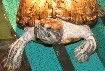
A Program That Allows Burying Them Alive Is Ending, But That May Not
Help Much.
By CRAIG PITTMAN, St. Petersburg Times ,May 7, 2007
Workers buried the 30-pound gopher tortoise on a Lee County construction
site, its shell crushed by a backhoe. Two weeks later, despite a spinal
injury, the determined tortoise dug its way out.
The remarkable resurrection led a wildlife expert to nickname the
16-inch-long tortoise "Phoenix." It was the largest gopher tortoise ever
found in the wild. It died last week.
For 16 years, Florida officials have allowed developers to bury
tortoises alive and pave over their burrows, in exchange for paying
money into a fund to buy land for tortoises elsewhere. Because of their
low metabolic rate, tortoises can take months to suffocate under
convenience store parking lots, shopping centers and new subdivisions.
By this year, the state's pay-to-pave program had issued permits to bury
more than 94,000 tortoises. Now the species is in sharp decline, and
tortoise experts blame the permitting program.
"It's a massive loss of tortoises, " said George Heinrich of Heinrich
Ecological Services in St. Petersburg and a former co-chairman of the
Gopher Tortoise Council, a group of biologists concerned about the
animal's future.
State wildlife officials have decided to end the program by July 31,
prompting a rush by developers to beat the deadline. Up to a dozen
applications a week have been sent in for the last permits to kill
tortoises, according to Rick McCann, who runs the permit program for the
Florida Fish and Wildlife Conservation Commission.
Four months ago, for instance, the Orlando-Orange County Expressway
Authority got a permit to kill more than 400 tortoises whose burrows
were in the path of a new highway.
Before the bulldozers could crank up, the Humane Society of the United
States lodged a protest. Last month the expressway authority agreed to
drop its plans to kill the tortoises and agreed to move them to a
tortoise preserve area in the 48, 000-acre Nokuse Plantation in the
Panhandle.
The Humane Society is eager to see the pay-to-pave program end, said
Jennifer Hobgood, program coordinator in the society's Tallahassee
regional office.
But Hobgood is concerned about the rush to beat the deadline. The
permits the state wildlife commission are issuing now have no expiration
date, so developers who get them can use them any time in the future.
"They would be permitted to kill limitless numbers of tortoises
indefinitely, " Hobgood said.
No one knows for sure how many gopher tortoises there are, but there are
more in Florida than anywhere else.
But the habitat gophers favor also is popular with developers. By 2003,
more than 1.7-million acres of Florida land that was once gopher
tortoise habitat had been turned into home sites, roads, shopping
centers and the like, according to the wildlife commission.
In 1979, state wildlife officials included them on a list of imperiled
animals as a "species of special concern." That meant no one could harm
or harass one without the state's permission.
Since 1991, developers who wanted to build in gopher tortoise habitat
could choose between two state-authorized solutions: write a check to
the state and pave over the burrows, suffocating the occupants; or pay
someone to find all the gopher tortoises and move them.
Moving the tortoises was the feel-good choice, McCann said, but it
didn't always work. The tortoises often tried to find their way home,
only to be run over. Or they carried a respiratory disease that then
spread to other tortoises already on their new home turf.
For a while, the state required developers who wanted to relocate
tortoises to pay to test them for the disease first, making that option
much more expensive than paying to kill the tortoises.
McCann contended that the pay-to-pave program was, in a way, better for
tortoises, because the money collected from developers was used to buy
and preserve 25, 000 acres of tortoise habitat.
But that makes up for only one-fifth of the habitat that's been wiped
out, Hobgood said.
Meanwhile, the government has sanctioned suffocating tens of thousands
of the animals.
In a report last summer, a panel of state wildlife experts, including
University of South Florida professor Henry Mushinsky, estimated that
the population of gopher tortoises in Florida has declined by more than
half in the past 60 to 90 years. That persuaded state officials to take
the first step toward bumping the tortoise up to "threatened, " one rung
below "endangered."
The change is long overdue, said Matt Aresco, conservation director of
Nokuse Plantation.

I just don’t understand these people, if I had to bury an animal alive I would have nightmares about it, they must not have a conscience. This also happens a lot with prairie dogs here in Colorado, people just don’t get that they are a keystone species to the ecosystem(just like the gofer tort), they are labeled as a pest animal, and are exterminated on a regular basis, they either plug up the holes and drowned them or they gas them. Its just horrible, I try to speak up for the environment a lot but people just role their eyes at me, they just really don’t get it, or they just plain don’t care. It just makes me so sad and frustrated that the Colorado prairie and it inhabitants will probably be gone within a few generations and the majority of the people don’t care and when they start to realize that there is a problem it will be far to late to fix it.